
Real film and TV locations across Scotland — see where to camp nearby and plan a visit.

Pennan is a tiny, sheltered fishing village on Scotland’s northeast coast, tucked beneath steep cliffs along the Moray Firth. With its whitewashed cottages, narrow single-track road, and dramatic sea views, it feels largely unchanged for decades and is known for its quiet, remote atmosphere. Pennan became internationally famous after appearing in the film Local Hero (1983), where its red telephone box on the seafront became an iconic symbol of the movie. The village was used extensively for exterior scenes, portraying the fictional coastal village of Ferness. Today, that same phone box remains a popular photo stop for visitors following in the footsteps of the film. Visitors to Pennan can walk the small harbour, explore the pebble beach, and take in sweeping coastal views where dolphins are sometimes spotted offshore. Nearby highlights include the villages of Gardenstown (Gamrie) and Crovie, both similarly picturesque and used in film and photography for their dramatic cliffside settings. The wider Aberdeenshire coastline offers quiet walking routes, historic fishing communities, and some of the most atmospheric coastal scenery in Scotland.
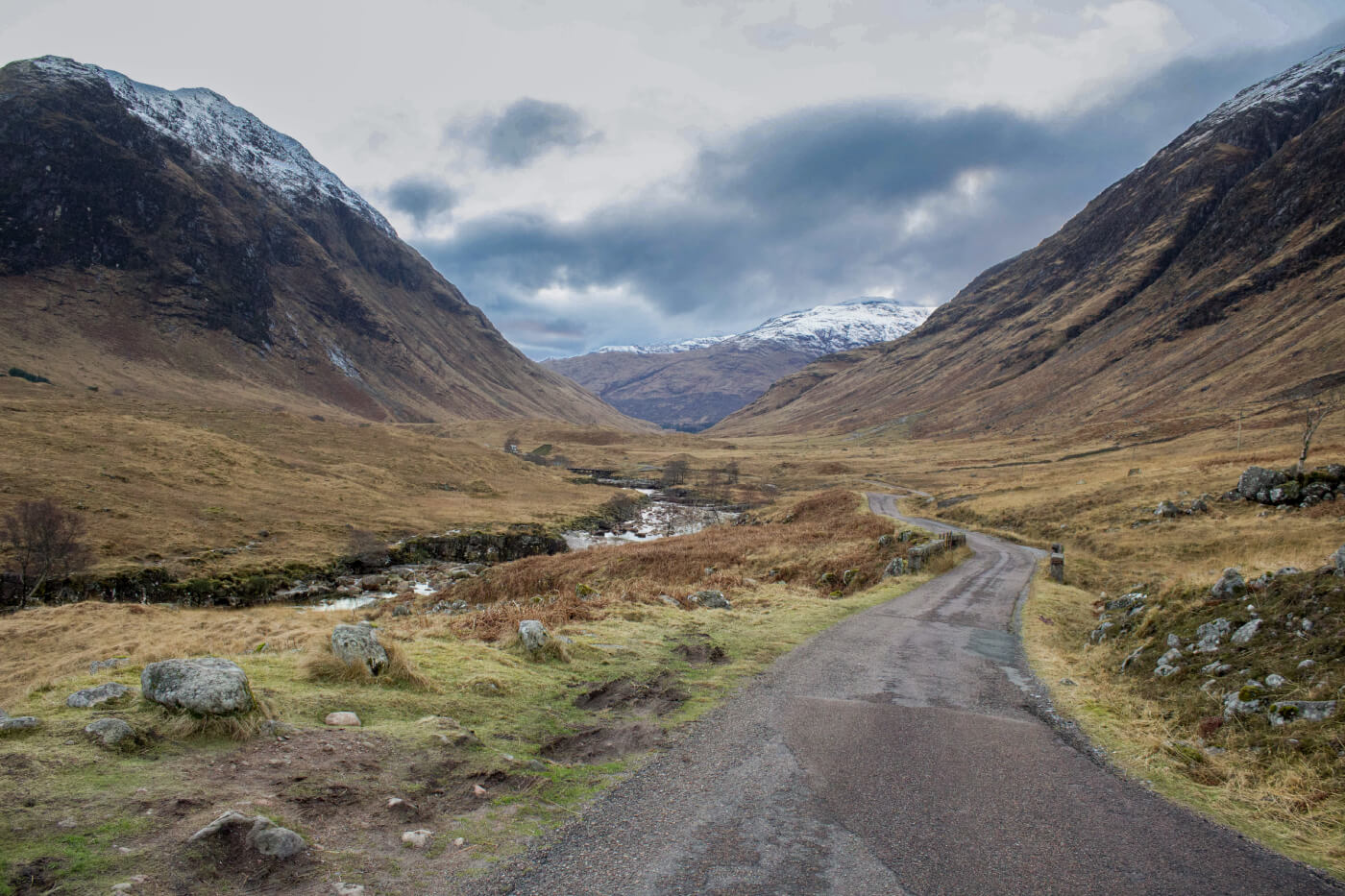
The single-track road through Glen Etive, off Glen Coe, is where James Bond drives Judi Dench's M north to his childhood home in the film's final act — one of the most striking Highland landscapes used in the Bond franchise.The Glen Etive Road is a spectacular, 12-mile single-track dead-end road in the Scottish Highlands. Branching off the A82 near the Glencoe Mountain Resort, it winds alongside the River Etive to the shores of Loch Etive.

The castle has a long history in film and television, most famously appearing in Highlander (1986), as well as major productions such as James Bond: The World Is Not Enough and several historical dramas. Its instantly recognisable silhouette makes it a popular stand-in for classic Highland and fantasy settings. Eilean Donan has returned to the spotlight for the new Highlander reboot (starring Henry Cavill), which has been filming on location in Scotland in 2026. Production has taken over the castle grounds for key scenes, reusing the location’s strong connection to the original film. Cast members including Cavill have been spotted filming period Highland sequences on site, with the castle again representing Clan MacLeod’s world and the wider 16th-century Scottish setting of the story. Today, visitors can explore the surrounding viewpoints overlooking the castle and lochs, the nearby village of Dornie, and the scenic drive toward Kyle of Lochalsh and the Isle of Skye. The area remains one of the most important stops on Scotland’s west coast, combining cinematic history, clan heritage, and some of the country’s most dramatic Highland scenery

St Abbs is a small, rugged fishing village on the southeast coast of Scotland, known for its dramatic cliffs, clear waters, and traditional stone cottages overlooking the North Sea. Originally called Coldingham Shore, it was renamed St Abbs after a nearby historic religious site, and it has remained a working fishing community while also becoming a popular stop for coastal walkers and photographers. The village gained global attention after featuring as New Asgard in Avengers: Endgame, where it was used as the setting for the relocated Asgardian settlement following the events of Infinity War. Its dramatic cliff-top scenery and remote coastal feel made it a perfect real-world match for the Marvel universe's mythological tone. Just north of the village is the spectacular St Abb's Head National Nature Reserve, a rugged headland managed by the National Trust for Scotland. It features dramatic sea cliffs, seabird colonies, and walking trails with sweeping views across the North Sea. Nearby, visitors can also explore Eyemouth, a historic harbour town with beaches, museums, and boat trips, as well as Coldingham Bay, a popular sandy beach for surfing and coastal walks. Together, St Abbs and its surrounding coastline offer a mix of cinematic fame, wildlife-rich nature, and some of the most striking coastal scenery in southern Scotland.

Doune Castle is a remarkably well-preserved medieval stronghold in Stirling, best known today for its extensive use as a filming location. It famously appears in Monty Python and the Holy Grail, where it stood in for multiple castles and interiors, with many of the film’s iconic scenes shot both inside the castle and in its surrounding grounds. It was also used in Outlander as Castle Leoch, and in Game of Thrones as Winterfell in the pilot episode, making it one of Scotland’s most recognisable screen locations. For Monty Python and the Holy Grail, several nearby landscapes around Doune and the River Teith were used for exterior scenes, including countryside sequences and approach shots to “swamp castles” and travelling knights. While there isn’t a dedicated “Holy Grail cave” at Doune itself, some of the film’s cave-like and forest scenes were shot in nearby rural areas of the Stirling and Callander region, where wooded glens and limestone features provided the backdrop for wandering knight sequences and encounters. Visitors to Doune Castle can explore the imposing gatehouse, great hall, and kitchen areas, many of which remain largely unchanged since the medieval period. Nearby, the historic town of Stirling offers Stirling Castle and the Wallace Monument, both rich in Scottish history and frequently linked with film productions and period dramas due to their dramatic settings. The surrounding Trossachs area also provides rugged landscapes that have been used in numerous historical and fantasy productions, making Doune a central hub for both cinematic and real-world Scottish heritage.

The Glenfinnan Viaduct is a striking 21-arch railway bridge set in the dramatic Highlands landscape near Fort William. It’s best known for its appearances in the Harry Potter films, where it features as the route taken by the Hogwarts Express, most famously in Chamber of Secrets and Prisoner of Azkaban. The steam train seen crossing the viaduct is the real-life Jacobite Steam Train, which still runs this scenic West Highland line today between Fort William and Mallaig. Visitors can take in panoramic views of the viaduct from several walking trails and viewpoints around Glenfinnan, with the most popular spot being the hillside above the Glenfinnan Visitor Centre. The centre itself provides insight into the Jacobite Rising of 1745 and the surrounding history of the area. Just a short walk away stands the Glenfinnan Monument, a striking tribute to Bonnie Prince Charlie overlooking Loch Shiel, while the nearby Glenfinnan Station Museum explores the story of the West Highland Railway and the steam era that brought the line to fame. Together, these attractions make Glenfinnan one of Scotland’s most iconic film and heritage destinations.

Scotland's second-highest waterfall, in Glen Nevis near Fort William, forms the dramatic backdrop to the Triwizard Tournament's first challenge in Goblet of Fire, and appears in the background of Quidditch scenes across five Harry Potter films.

Glencoe is one of the most dramatic and historically significant glens in the Scottish Highlands, carved by ancient glaciers and dominated by towering peaks such as the famous Three Sisters. It is also known for the Massacre of Glencoe in 1692, when members of the MacDonald clan were killed by government troops after a delayed oath of allegiance, an event that has left a lasting sense of atmosphere and history across the valley. The glen has been used extensively in film thanks to its raw, cinematic landscape. It appears in James Bond: Skyfall, where it represents Bond's ancestral Scottish home, and features in Harry Potter and the Prisoner of Azkaban, with sweeping Highland scenery used for travel shots around the Hogwarts journey. It also appeared in the original Highlander (1986), and Glencoe together with neighbouring Glen Nevis are confirmed filming locations for the 2026 Highlander reboot. One of the most notable filming locations in the area is Hagrid's Hut from Harry Potter and the Prisoner of Azkaban. The exterior set was built in Glencoe on the lower slopes of Sgorr nam Fiannaidh near Clachaig Gully, overlooking Torran Lochan, using the dramatic mountainside to create the isolated, rugged feel of Hagrid's home within Hogwarts grounds. Today, visitors come to Glencoe for both scenery and history. The Glencoe Visitor Centre (National Trust for Scotland) explains the geology of the glen and the events of 1692, while walking routes such as the Lost Valley (Coire Gabhail) offer access to a hidden gorge once used by the MacDonald clan. The nearby A82 provides some of Scotland's most famous viewpoints, making Glencoe one of the most photographed and atmospheric landscapes in the country.

Rosslyn Chapel is one of Scotland’s most intricate and mysterious historic buildings, located just south of Edinburgh in the village of Roslin. Founded in 1446 by William Sinclair, the chapel is renowned for its extraordinary stone carvings, rich symbolism, and legends that have grown around its history over the centuries. Its detailed interior, covered in biblical imagery, pagan motifs, and enigmatic “Green Men” carvings, has made it one of the most studied and photographed medieval chapels in Europe. Rosslyn Chapel gained worldwide attention after featuring prominently in The Da Vinci Code, where it is portrayed as a key location tied to the Holy Grail mystery. This appearance introduced the chapel to a global audience and reinforced its reputation as a place of intrigue, symbolism, and hidden meaning. Today, visitors can explore the chapel interior, guided exhibitions, and nearby woodland walks in Rosslyn Glen, which features ruins, river scenery, and atmospheric paths leading to Rosslyn Castle nearby. The surrounding area blends history and legend, making Rosslyn Chapel one of Scotland’s most compelling cultural and cinematic landmarks.

Loch Shiel is a stunning freshwater loch in the Scottish Highlands stretching for around 17 miles (28 km) from Glenfinnan south-west into the remote wilderness. Its northern tip lies at Glenfinnan, just a short walk from the famous Glenfinnan Viaduct, making it easy to visit both landmarks together. The loch stood in for Hogwarts' Black Lake throughout the Harry Potter films, while its shores were also used in Highlander for the memorable training scenes between Connor MacLeod and Ramirez. Surrounded by dramatic mountains and unspoilt scenery, Loch Shiel is one of Scotland's most iconic film locations.

Dunure Castle is a quiet clifftop ruin on the Ayrshire coast, once a stronghold of the Kennedy family. Its jagged remains overlooking the Firth of Clyde have featured on screen in Outlander.

Blackness Castle is a formidable 15th-century fortress on the south shore of the Firth of Forth, near Linlithgow. Its long, angular shape earned it the nickname 'the ship that never sailed', and over the centuries it served as a royal castle, state prison and garrison fortress. Now cared for by Historic Environment Scotland, its stark stone ramparts have become a favourite film and television location — most famously standing in as Fort William, the headquarters of Black Jack Randall, in Outlander, as well as appearing in Hamlet and Outlaw King.